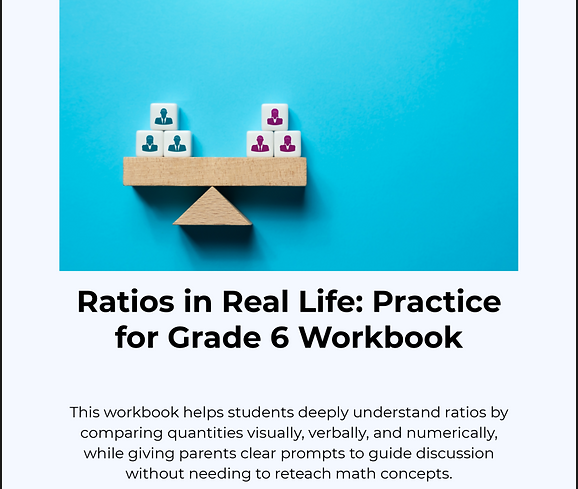
Understanding Ratios and How They Compare Quantities
Grade Level:
6th Grade
Topics:
Ratios
Duration:
20-25 Mins

What you’ll learn
In this lesson, you’ll learn what ratios are, how to write them in different ways, and how they help us compare quantities clearly and fairly.
Why this matters
Ratios are used in cooking, shopping, sports statistics, maps, and science. Understanding ratios helps students move toward proportional reasoning, which is essential for algebra and real-world problem solving.
What is a ratio?
A ratio compares two quantities by showing how much of one thing there is compared to another.
Example:

If there are 3 red apples and 2 green apples, the ratio of red apples to green apples is 3 to 2.
Ratios do not tell the total — they focus on comparison.
Ways to write a ratio
The same ratio can be written in three common ways:
3 to 2
3 : 2
3/2
All three mean the same thing: for every 3 of one quantity, there are 2 of another.
Understanding what ratios mean
A ratio describes a relationship.
If the ratio of boys to girls in a class is 4 to 5, that means:
For every 4 boys, there are 5 girls
The numbers grow together but keep the same comparison
This idea prepares students for understanding proportions later on.
Visualizing ratios

Imagine bags of marbles:
5 blue marbles
3 red marbles
The ratio of blue to red marbles is 5 to 3.
If you double both quantities:
10 blue marbles
6 red marbles
The ratio stays the same because the relationship didn’t change.
Step-by-step examples
Example 1:

A recipe uses 2 cups of flour and 1 cup of sugar.
Ratio of flour to sugar = 2 to 1
Example 2:

A parking lot has 12 cars and 8 trucks.
Ratio of cars to trucks = 12 to 8
This ratio can be simplified to 3 to 2
Try it together (Parent + Student)
Look around your home. Pick two groups of objects (spoons and forks, shoes and socks).
Count each group
Write the ratio in two different ways
Talk about what the ratio means in words
Independent practice
Students write ratios from pictures, tables, and short word problems to build fluency.
Common mistakes to avoid
❌ Mixing up the order of the ratio
❌ Thinking ratios tell the total
❌ Comparing quantities with different units incorrectly
If you can explain what a ratio compares and why order matters, you understand this lesson.